Applied AI

AI Agent Development Services

AI agent development for teams that want an agent to do real, bounded work — not a general assistant that impresses once. From an AI/ML architect and CTO who has built and operated a scheduled engineering agent in a live programme.

What an AI agent actually is, and when to build one

What an AI agent actually is, and when to build one

An AI agent is a system that uses a model to decide and act across several steps — choosing tools, taking actions, and checking results — rather than answering a single prompt. It is worth building when a task has clear tools, results that can be verified automatically, and a tolerance for supervision, so the agent can make progress while a human stays accountable for the decisions that matter. It is the wrong choice when a single generation or retrieval step would do the job more cheaply and predictably, or when there is no way to check whether the agent's work is correct. This service starts by deciding, honestly, which side of that line your task sits on — and only then designs the agent.

01

In depth

A working agent in production, not a demo

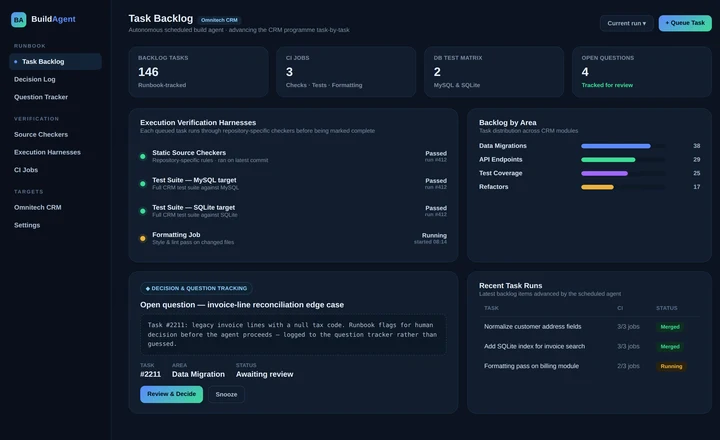
The Autonomous Scheduled Build Agent is a concrete example of an agent doing real, bounded work: on each run it selects one backlog item, follows a repository-specific runbook, records its decisions, and must pass static checkers and execution verification harnesses before the work is marked complete. Human decision points stay explicit in the programme. That is the shape of an agent worth building — narrow scope, verifiable output, and a person accountable for direction — rather than an open-ended assistant asked to do everything and trusted to have done it right.

02

In depth

Tools, boundaries, and verification are the real work

The model is the smallest part of an agent. Most of the engineering is in the surface around it: the tools the agent may call, the boundaries on what it may touch, the checks that decide whether a step succeeded, and the record of what it did and why. On the build agent that took the form of repository-specific checkers and execution harnesses that gate completion, plus explicit decision and question tracking. Any agent engagement here spends its effort in the same places, because that is what makes an agent's output trustworthy instead of merely plausible.

03

In depth

Evaluation: knowing whether the agent is actually good

An agent that cannot be measured cannot be improved or trusted. Before scaling one, you need a way to tell a good run from a bad one — checkable completion criteria, a record of decisions, and repeatable standards a run must meet. That evaluation layer is designed alongside the agent, not bolted on afterwards, so that changes to prompts, tools, or models can be judged against evidence rather than impressions.

04

In depth

Keeping a human accountable

Autonomy is a spectrum, not a switch. The right level depends on the cost of a mistake: low-stakes, easily-reversed work can run with light supervision, while consequential actions keep a human in the loop by design. A responsible agent makes its decision points visible and its actions reversible where possible, so the team keeps control of the outcomes the agent is producing. This is a deliberate design choice, made per task, not an afterthought.


Fit

Who this helps

  • Teams with a repetitive, multi-step task that has clear tools and checkable results, wondering whether an agent could own it.
  • Product leaders who have seen an impressive agent demo and need to know whether it can be made reliable enough to ship.
  • Companies that want automation with accountability — an agent whose decisions and actions they can see and control.
  • Businesses deciding between a full agent and a simpler generation or retrieval step, and wanting an honest answer.

Scope

What's in scope

  • Task assessment: whether an agent is the right tool, and at what level of autonomy
  • Agent architecture: tools, boundaries, memory, and control flow
  • Verification and guardrails that gate each step and the final result
  • Evaluation design so run quality can be measured and tracked
  • Human-in-the-loop and reversibility design sized to the cost of a mistake
  • Delivery of the agent, or an architecture handed to your engineering team

Deliverables

What you get

  1. A written recommendation on whether to build an agent, and at what autonomy level, with the reasoning
  2. An agent architecture covering tools, boundaries, verification, and control flow
  3. An evaluation approach with repeatable completion criteria
  4. A built agent, or a build plan your engineering team can execute

Evidence

Related work

Autonomous Scheduled Build Agent project illustration

Autonomous Scheduled Build Agent

Scheduled agent that advances a CRM programme task by task using a runbook, backlog, checkers, and explicit verification standards.

Pulse / MyOmniHub project illustration

Pulse / MyOmniHub

Modular Laravel platform combining multichannel publishing, AI-assisted content, public forms, hiring workflows, websites, and tenant storefronts.

Further reading

Related technical writing

AI Agent vs Chatbot: Which Does Your Business Need? → AI Agent Use Cases for Business → How to Create an AI Agent → AI Agent Frameworks: Practical Tradeoffs → Chat With Your Data: What It Takes to Do It Well →

A clear starting point

Start with a defined engagement.

Choose the right engagement based on your goals. All offers have a clear process, defined scope and commercial terms agreed before work starts.

  • Focused expertiseSenior technical judgement
  • Clear processScope agreed before start
  • No surprisesTransparent terms

Showing 01 of 01

Showing all offers.

Questions and answers

AI agent development: common questions

More questions? Feel free to reach out.

Explore all services →
When is an AI agent the right tool, and when is it overkill?

An agent earns its place when a task has clear tools, results that can be checked automatically, and a tolerance for supervision. If a single generation or retrieval step would do the job, that is more reliable and cheaper. The first thing an engagement establishes is which of those two your task actually is — an honest answer here saves the most money.

How do you stop an AI agent from doing something wrong?

With boundaries and verification, not trust. The agent is given a defined set of tools and limits on what it may touch, each step is gated by checks that decide whether it succeeded, consequential actions keep a human in the loop, and actions are made reversible where possible. On the scheduled build agent, completion is gated by static checkers and execution harnesses before work is accepted.

How do you know whether an agent is actually working well?

By measuring it. Before scaling an agent you need checkable completion criteria, a record of its decisions, and repeatable standards each run must meet, so a good run can be told from a bad one. That evaluation layer is designed alongside the agent so that prompt, tool, or model changes can be judged against evidence rather than impressions.

Can an agent run fully autonomously?

Sometimes, but autonomy is a spectrum chosen by the cost of a mistake. Low-stakes, easily-reversed work can run with light supervision; consequential actions keep a human accountable by design, with visible decision points. The right level is decided per task rather than assumed, so the team keeps control of the outcomes.

What does an AI agent engagement start with?

With a task assessment, not a build. It looks at your candidate task, its tools, how results can be verified, and the cost of a wrong action, and returns a clear recommendation on whether to build an agent and at what autonomy level. Implementation, if it makes sense, is scoped from there.

Let's build what's next

Have a complex system that needs to be built right?

Whether you are starting from an idea, replacing an existing platform, or scaling a system, let's talk.

Better Technology.
Brighter Possibilities.