Creating an AI agent that works in production is mostly not about the model. It is about the loop around it: the tools the agent can use, the boundaries on what it may do, the checks that decide whether each step succeeded, and the way you measure whether the whole thing is any good. A demo skips most of that; a production agent cannot. This is the shape of the work, in the order it usually matters.
01Reading the work
Start with the decision to build one at all
Before building, confirm the task is agent-shaped: multiple steps, checkable results, tolerant of supervision. If it is really one step, a single model call with retrieval is more reliable. This is not a formality — most of the cost and risk of an agent comes from autonomy, so the first design decision is how little autonomy the task actually needs.
02Reading the work
Give it tools and a reason-act loop
An agent acts by calling tools and reacting to what they return. The ReAct pattern — interleaving reasoning with actions and observations — is the well-known formulation of this loop (cited below). In practice you define a small, well-scoped set of tools, describe them clearly, and let the model decide which to call, then feed the result back. Fewer, sharper tools beat a large, vague toolbox almost every time.
03Reading the work
Constrain it and verify every step
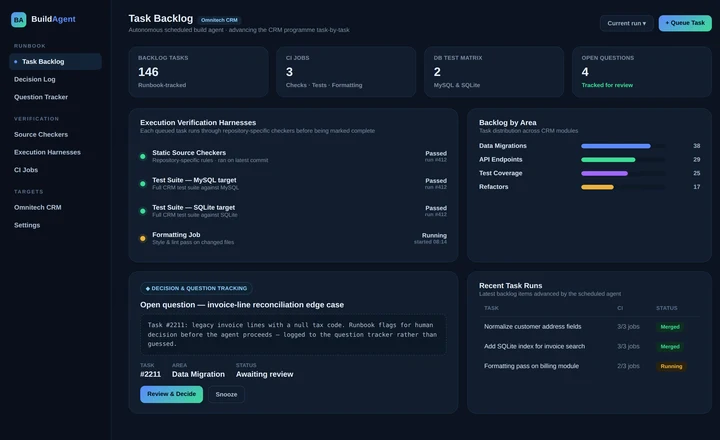
Boundaries and checks are the real engineering. Limit what the agent may touch, gate each step with a check that decides success or failure, keep a human in the loop for consequential actions, and make actions reversible where possible. The Autonomous Scheduled Build Agent shows the pattern: repository-specific checkers and execution harnesses gate completion, and decisions and open questions are tracked, so the agent's output is trusted because it was verified — not assumed.
04Reading the work
Evaluate before you scale
An agent you cannot measure cannot be improved or trusted. Design an evaluation approach alongside the agent: repeatable completion criteria, a record of decisions, and standards each run must meet, so changes to prompts, tools, or models can be judged against evidence. Only once a good run can be reliably told from a bad one is it safe to widen the agent's scope or autonomy.