What private AI is, and when it is worth it
What private AI is, and when it is worth it
Private AI means running AI models on infrastructure you control — on-premise or in your own cloud account — instead of sending your data to a third-party API. It is worth it when data cannot leave your environment for legal, contractual, or competitive reasons, when volume makes hosted pricing uneconomical, or when you need control and predictability that a hosted service cannot guarantee. It is not always worth it: hosted models are faster to start and often cheaper at low volume. This service gives an independent read on which side of that line you are on, and — when private AI is right — how to do it without underestimating the operational cost. Deployment itself is delivered through the Self-Hosted AI Deployment service; this page is the strategy and decision.
01In depth
The hosted-versus-private decision, honestly
The most valuable part of a private AI engagement is often the decision not to do it, or to do it only for part of the workload. The decision turns on data sensitivity, volume and cost, latency, and how much control you genuinely need — and it is made per use case, not as a blanket rule. An honest assessment will tell you when a hosted model with the right data agreement is the better answer, because the goal is the right outcome, not the more expensive one.
02In depth
Data sovereignty and control
For many businesses the driver is not cost but control: data that cannot leave a jurisdiction or an environment, contractual commitments to customers, or the simple wish not to depend on a third party's terms and availability. Private AI keeps the data and the model in your control. The engineering job is to deliver that control without pretending the operational burden away — because a private deployment you cannot run reliably is not control, it is risk.
03In depth
Cost and operations are the real question
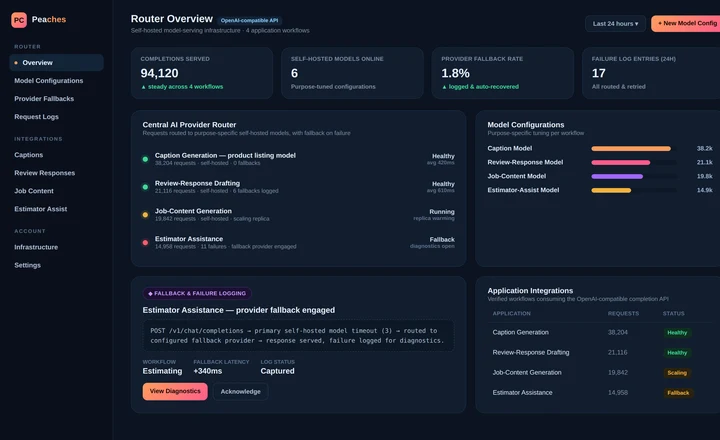
Standing up a private model is the easy part; running it reliably and affordably is the real question. That means the cost and operational load month after month — hardware or cloud spend, inference reliability, model routing and fallback, and the people to keep it healthy — not just the one-time setup. The Peaches work is a concrete example of self-hosted AI architecture with model routing treated as an operational concern, and that operational lens is what a private AI strategy has to include to be honest.
04In depth
From strategy to deployment
When the assessment says private AI is right, the path to production is a deliberate one: model selection, a deployment architecture with routing and fallback, and an operations plan sized to the workload. That deployment is delivered through the Self-Hosted AI Deployment service, which this page links to; the two together cover the decision and the execution, kept distinct so the recommendation to go private is never shaped by an incentive to build.