The best AI agent use cases share a shape, not an industry: a multi-step task with clear tools, results that can be checked, and a tolerance for supervision. When a use case has that shape, an agent can do real work; when it does not, an agent is an expensive way to be unreliable. This is a tour of the categories that tend to fit, with the condition that makes each one viable — because the use case is only half the decision, and the other half is whether the work can be verified.
01Reading the work
Bounded engineering and operations work
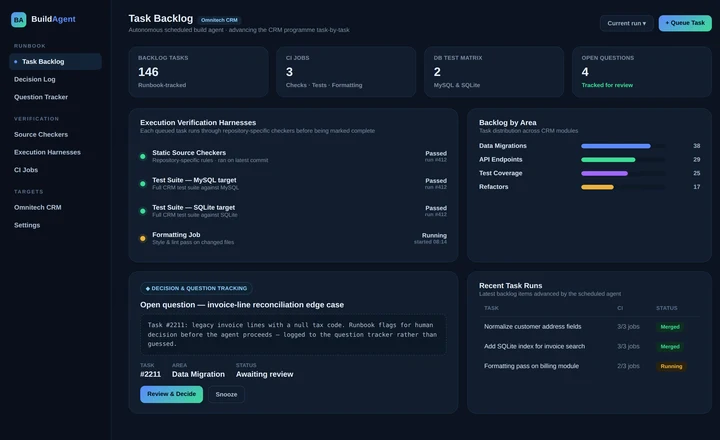
Repetitive, rule-bound engineering and operations tasks are a strong fit when each step can be checked. The Autonomous Scheduled Build Agent is a concrete example: it advances a programme one backlog item at a time, gated by static checkers and execution harnesses, with human decision points explicit. The condition that makes it work is verification — the agent is only trusted because its output has to pass checks, not because it is assumed to be right.
02Reading the work
Research and synthesis with a human reviewer
Agents that gather information across sources and synthesise it are useful when a person reviews the result before it is used. The value is breadth and speed; the guardrail is that the output is a draft, not a decision. This fits competitive research, document review, and first-pass analysis — provided the interface makes it easy to see where each claim came from, so the reviewer can trust or reject it quickly.
03Reading the work
Customer and internal workflows with tool access
Agents that take actions in real systems — creating tickets, updating records, orchestrating a workflow — fit when the actions are reversible or supervised and the tools are well defined. In a platform context such as Pulse / MyOmniHub, that means treating the agent's tools and boundaries as ordinary system components with the same operational discipline as the rest of the platform, not as a magic layer bolted on.
04Reading the work
Where agents do not fit
Skip the agent when the task is a single step, when nothing can verify the result, or when a wrong action is costly and cannot be supervised. In those cases a chatbot with retrieval, or a narrow piece of deterministic automation, is more reliable and cheaper. The discipline is to match the tool to the task's shape rather than reaching for an agent because the category is fashionable.