What self-hosting actually changes
What self-hosting actually changes
Self-hosting does not remove infrastructure cost — it converts a metered, per-token third-party bill into owned compute, storage, and operational responsibility. That tradeoff is worth making when a product's AI usage is predictable and ongoing enough that owning the infrastructure costs less over time, when the product needs models tuned to a narrow, purpose-specific task rather than a general-purpose one, or when keeping requests and data inside owned infrastructure is a requirement rather than a preference. It is a worse tradeoff for unpredictable, spiky, or exploratory AI usage, where a metered API's flexibility outweighs the fixed cost of owned infrastructure.
01In depth
A router in front of purpose-tuned models
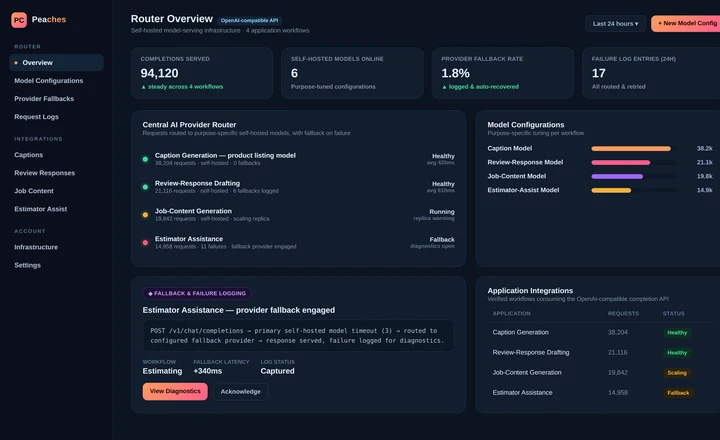
Peaches, built at Omnitech, is a self-hosted model-serving platform: it stands up an OpenAI-compatible completion API in front of purpose-tuned models, then routes application traffic — captions, review-response drafting, job-content generation, and estimator assistance — through a central provider router with configured fallback and failure logging. That architecture is the concrete shape of this service: an application layer that calls one internal, stable API; a routing layer that decides which model serves which workload; and an operating layer responsible for keeping the models themselves running.
02In depth
Operating responsibility, not just infrastructure
Standing up a self-hosted model is the easy part; operating it is the actual service. That means monitoring the models themselves for latency and failure, configuring provider fallback so a degraded or unavailable self-hosted model does not take a dependent feature down with it, and logging failures with enough detail to diagnose them rather than retrying silently. Peaches' router does exactly this: each of its four application workflows is monitored independently, with fallback and failure logging designed into the routing layer rather than added as an afterthought.