

The challenge
Keep shared AI workflows under operational control.
Provide reusable AI generation across several product workflows while keeping the primary model service under operational control.
AI & Infrastructure
Self-hosted AI case study covering a compatible completion API, workload-based model routing and configured provider fallback.
Project overview
Peaches is a self-hosted, OpenAI-compatible LLM service integrated into production workflows for captions, review responses, job content, and estimating. Applications can select purpose-specific models and use controlled fallback behavior when configured.
The challenge
Provide reusable AI generation across several product workflows while keeping the primary model service under operational control.
Technical approach
A compatible completion interface centralizes provider routing and selects models by use case. Pulse treats Peaches as its primary AI service and can use a configured external fallback for workflows where continuity is required.
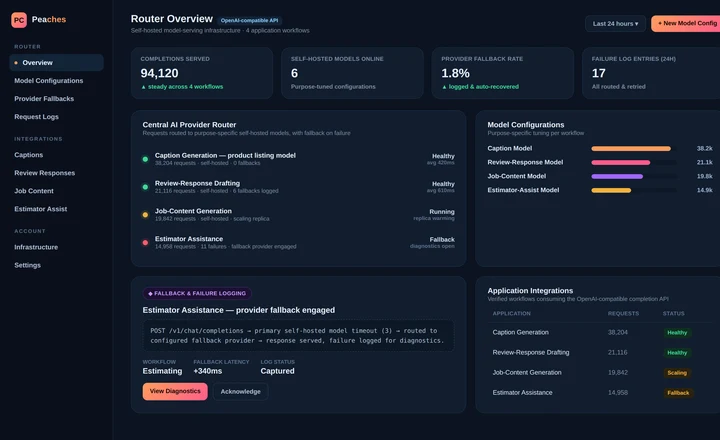
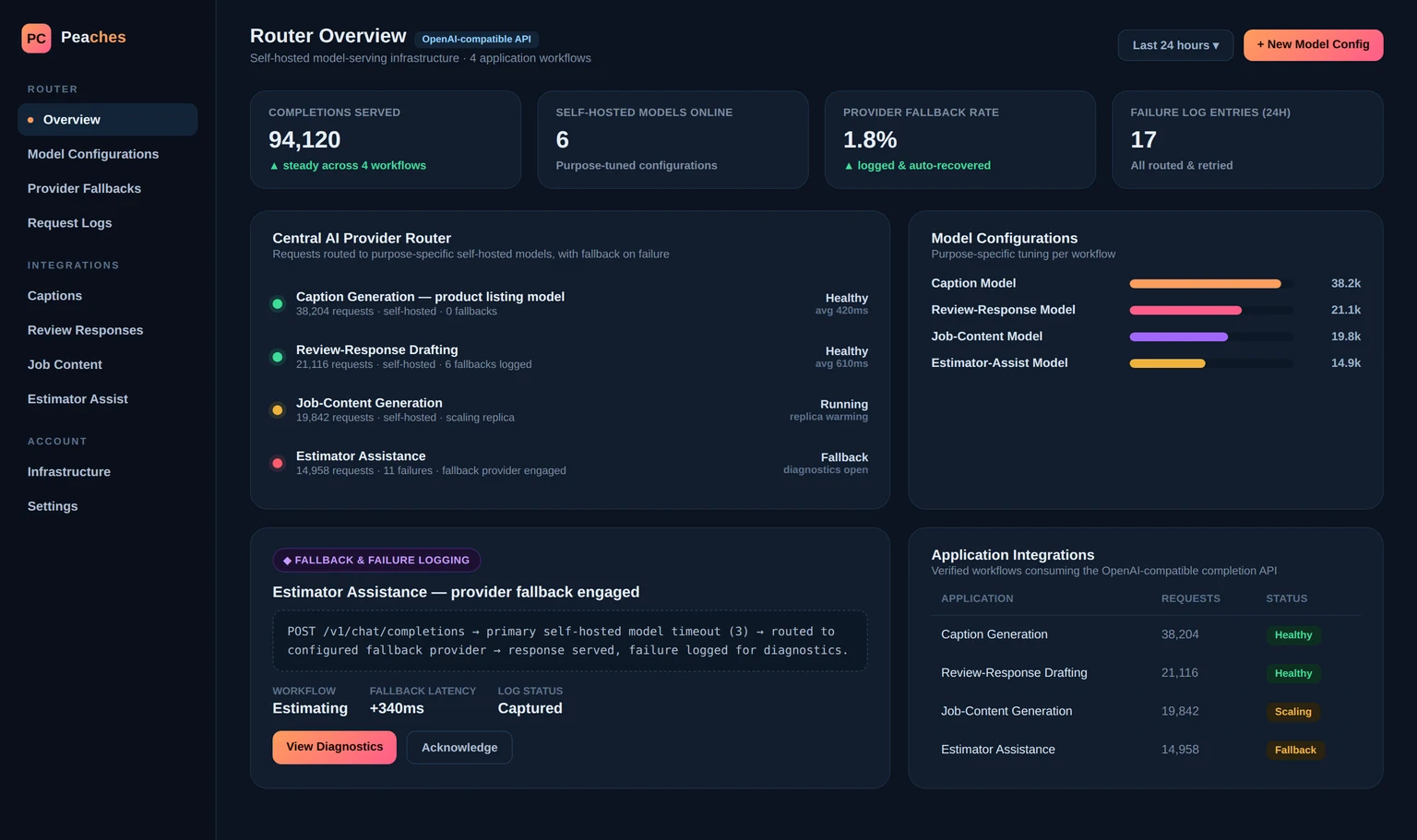
Central AI provider router — concept visualization
Illustrative dashboard built from Peaches' documented capabilities: purpose-specific self-hosted model configurations, an OpenAI-compatible completion API, and fallback/failure logging across the four verified application workflows. Not a screenshot of the live service.
Products and interfaces
Platform breadth
Evidence
Business context
Captions, review responses, job content, and estimating share a model-serving interface rather than each carrying separate provider logic. Configured fallback gives selected workflows another route when continuity is required. Self-hosting also brings infrastructure and operating responsibility.
The portfolio documents four application workflows and a compatible serving interface. No independently measured cost savings, accuracy, uptime, or response-time results are claimed here. Concept visuals illustrate the documented system; they are not production measurements.
Before committing to private AI, evaluate workload suitability, failure behavior, data boundaries, and total operating cost alongside model quality.
Facing a similar problem?
For teams planning an AI feature, an agent or a private model who need evidence before committing budget.
Request an assessmentExplore the approach
Questions and answers
More questions? Feel free to reach out.
Discuss a related project →Peaches is a self-hosted, OpenAI-compatible LLM service integrated into production workflows for captions, review responses, job content, and estimating. Applications can select purpose-specific models and use controlled fallback behavior when configured.
The work includes Self-hosted model-serving infrastructure, OpenAI-compatible completion API, Central AI provider router, Purpose-specific model configurations, Application integrations and diagnostics, Fallback and failure-logging controls.
Muhammad Muzammil Qureshi served as Chief Technology Officer, with responsibility spanning technology direction, architecture, delivery, and the operating systems described in this case study.
Peaches uses Self-hosted LLMs · Purpose-tuned models.
Let's build what's next
Whether you are starting from an idea, replacing an existing platform, or scaling a system, let's talk.
Better Technology.
Brighter Possibilities.