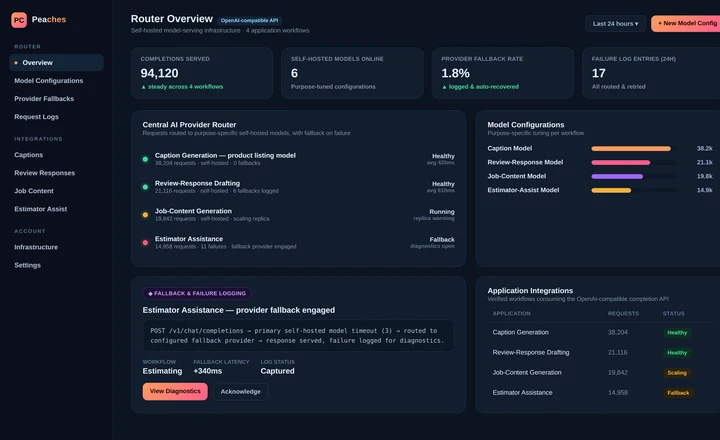
Standing up a self-hosted model is a one-time task. Operating it in production, for real application traffic, is an ongoing one — and that operating discipline is where Peaches, a self-hosted LLM platform built at Omnitech, actually lives.
01Reading the work
One API, several purpose-tuned models
Peaches exposes a single OpenAI-compatible completion API to application code — the same interface shape documented in the public OpenAI API reference (cited below) — and routes each request to one of several purpose-tuned models behind it, depending on the workload: captions, review-response drafting, job-content generation, and estimator assistance. Application code never has to know which model, or how many, are actually serving it; that decision belongs entirely to the router.
02Reading the work
Fallback is a routing decision, not an error handler bolted on after
When a self-hosted model times out or degrades, the router can fail the request outward, or it can fall back to a configured alternate provider and keep serving the workflow while logging the failure for diagnosis. Peaches is built around the second option: fallback is part of the router's designed behavior for every workflow it serves, not an exception path added after an outage.
03Reading the work
Logging failures instead of hiding them
A silent retry hides the fact that a model degraded at all. Peaches logs each fallback event with enough detail — which workflow, which model, what the primary attempt returned — to diagnose recurring failures rather than just absorbing them. That log is what turns "the AI feature felt slow yesterday" into an actual, specific incident that can be investigated.
04Reading the work
What actually requires ongoing attention
The operating load of self-hosted AI is monitoring latency and failure per workload, keeping fallback providers correctly configured as usage patterns shift, and reviewing the failure log for patterns rather than treating each fallback as an isolated event. None of this is exotic — it is the same operational discipline any production service needs — but it is easy to under-scope when a self-hosted model deployment is planned only as far as "stand the model up."