The short answer: a chatbot answers questions in a conversation; an AI agent takes a goal and works toward it across several steps, using tools and checking its own results. Most businesses that think they need an agent actually need a good chatbot with retrieval, and the ones that genuinely need an agent are the ones with a multi-step task that can be verified. The distinction matters because an agent costs more to build, is harder to make reliable, and fails in more interesting ways — so it should be chosen on purpose, not by default.
01実績の読み方
What a chatbot is good at
A chatbot is a conversational interface over a model, usually grounded in your content through retrieval so it answers from your data rather than making things up. It is the right tool when the job is to answer questions, explain, draft, or route — single steps where a person stays in control of what happens next. Most customer-support, internal-knowledge, and lead-qualification use cases are chatbot-shaped: they need good grounding and a clear hand-off to a human, not autonomy.
02実績の読み方
What makes something an agent
An agent uses a model to decide and act over multiple steps — selecting tools, taking actions, and reacting to the results — rather than producing a single response. Anthropic's guidance draws a useful line between workflows, where the steps are fixed in code, and agents, where the model directs its own process (cited below). The practical test is simple: if the task needs the system to take actions and check outcomes on its way to a goal, it is agent-shaped; if it needs a good answer, it is chatbot-shaped.
03実績の読み方
How to decide
Start from the task, not the technology. Ask three questions: does the work take several steps that vary case by case; can each step's result be checked automatically; and is a wrong action recoverable or supervised? Three yeses point toward an agent. If the work is really one step, or nothing can verify the result, a chatbot with retrieval — or a smaller piece of automation — will be more reliable and far cheaper to run.
04実績の読み方
A real example of the agent case
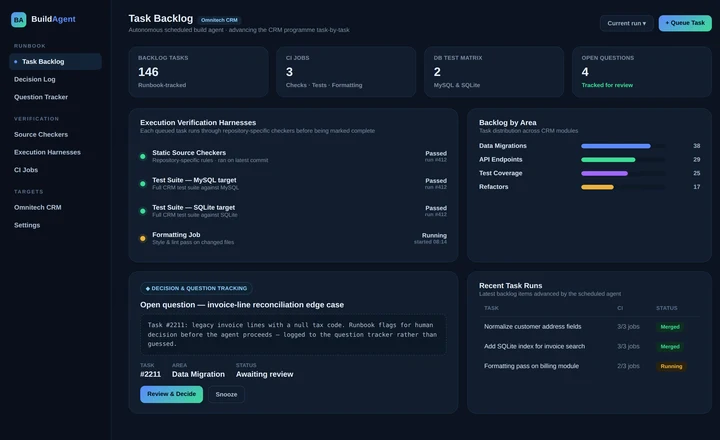
The Autonomous Scheduled Build Agent is agent-shaped for exactly these reasons: each run selects a bounded task, follows a runbook, and must pass static checkers and execution harnesses before the work is accepted, with human decision points kept explicit. That is the profile where an agent earns its cost — clear tools, verifiable results, and supervision — and it is the exception, not the default. When a use case does not look like that, the honest recommendation is usually a chatbot.