Applied AI

Servizi di consulenza AI Generativa

Independent generative AI consulting for founders and business leaders who want a clear answer on where AI helps, what it costs to run, and how to build systems their team can operate — from an AI/ML architect and CTO who has shipped AI features inside real products.

When generative AI is the right tool, and when it is not

When generative AI is the right tool, and when it is not

Generative AI is worth adopting when a task involves language, unstructured content, or judgement that rules-based software handles badly, and when a wrong answer has a manageable cost or a human stays in the loop. It is the wrong tool when the job needs deterministic, auditable results, when the data to ground it does not exist, or when a smaller, cheaper piece of automation would do the same work more reliably. This service starts from that distinction. Before any build, it establishes which of your problems generative AI genuinely fits, what a responsible version looks like, and what it will take to operate once the launch excitement is over — so the investment goes into systems that keep working, not demos that impress once.

01

In dettaglio

A use-case assessment before a build

Most generative AI disappointment traces back to a use case that was never a good fit, or one that was right but scoped without regard for data, cost, or operations. An assessment looks at the candidate use cases you have in mind, the data available to ground them, the accuracy and latency the task actually requires, and the cost of being wrong. The output is a short, honest ranking: what to do now, what to pilot, and what to leave alone — with the reasoning written down so the decision survives a change of team. This is deliberately separate from implementation, so the recommendation is not shaped by an incentive to sell more build hours.

02

In dettaglio

Systems you can operate, not demos

A demo answers one question in a meeting. A production AI feature has to answer thousands, handle the inputs nobody anticipated, degrade sensibly when a model or provider fails, and stay within a cost envelope. On Pulse / MyOmniHub, AI capabilities were built as part of a modular SaaS platform rather than bolted on, which meant treating retrieval, prompting, and fallback as ordinary system components with the same operational discipline as the rest of the platform. The same standard applies here: an AI system is designed to be run, monitored, and paid for month after month, not just to pass a first look.

03

In dettaglio

Grounding, retrieval, and keeping outputs honest

Generative models are fluent whether or not they are correct, so most of the engineering in a trustworthy AI feature is the work that surrounds the model: grounding answers in your own data, retrieving the right context, constraining what the system is allowed to claim, and giving people a way to see where an answer came from. In data-heavy work such as ProfileDriver's marketing intelligence, the value was never the model alone but the pipeline and validation around it. Expect the same emphasis here — the model is a component, and the reliability comes from the architecture around it.

04

In dettaglio

Agents, where they earn their place

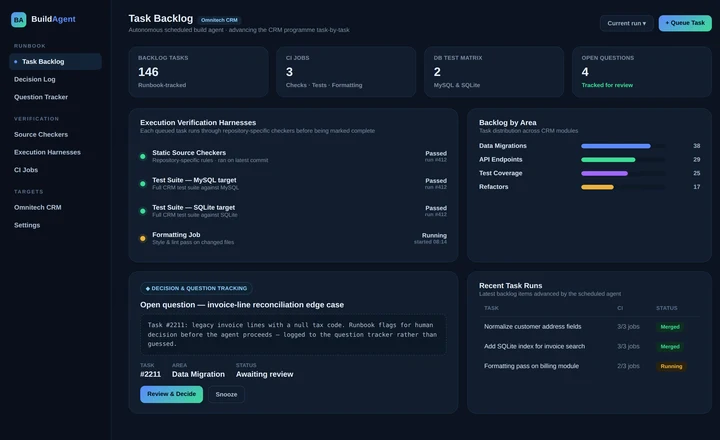
Autonomous and semi-autonomous agents are useful when a task has clear tools, checkable results, and a tolerance for supervision — and a liability everywhere else. The Autonomous Scheduled Build Agent is a concrete example of an agent doing real, bounded work on a schedule rather than a general assistant promised to do everything. When an engagement points toward agents, the same test applies: define the tools, make the results verifiable, set the boundaries, and keep a human accountable. If a simpler generation or retrieval step does the job, that is what gets recommended.


Adattamento

A chi si rivolge

  • Founders and business leaders deciding whether, and where, to invest in generative AI without a trusted technical advisor to ask.
  • Companies with a shortlist of AI ideas that need honest prioritisation before committing budget.
  • Product teams that have a working prototype and now need it to be reliable, affordable, and operable in production.
  • Businesses burned by an AI proof-of-concept that impressed once and could never be shipped.

Ambito

Cosa rientra nell'ambito

  • Use-case assessment and prioritisation against data, accuracy, cost, and operational fit
  • Solution and system architecture: model selection, retrieval and grounding, guardrails, and fallback
  • Data readiness review for grounding and retrieval
  • Build-vs-buy and hosted-vs-self-hosted model recommendations
  • Cost, latency, and evaluation planning so quality can be measured, not assumed
  • Delivery of the system, or an architecture handed to your engineering team

Deliverable

Cosa si ottiene

  1. A written use-case assessment with a clear now / pilot / avoid recommendation and the reasoning behind it
  2. A reference architecture for the chosen use case, covering retrieval, guardrails, fallback, and operations
  3. An evaluation approach so answer quality and cost can be tracked over time
  4. A build plan your team can execute, or a delivery engagement scoped separately

Evidenze

Lavori correlati

Pulsare / MyOmniHub illustrazione del progetto

Pulsare / MyOmniHub

Piattaforma modulare Laravel che unisce pubblicazione multicanale, contenuti assistiti da IA, moduli pubblici, flussi di selezione del personale, siti web e vetrine per i tenant.

ProfiloDriver illustrazione del progetto

ProfiloDriver

Piattaforma di marketing intelligence per il settore automobilistico che utilizza dati storici di concessionarie canadesi, data mining avanzato e strategie assistite da LLM per automatizzare inviti mirati ai clienti.

Agente di Costruzione Programmata Autonoma illustrazione del progetto

Agente di Costruzione Programmata Autonoma

Agente pianificato che porta avanti un programma CRM attività per attività, utilizzando un runbook, un backlog, controlli automatici e standard di verifica espliciti.

Approfondimenti

Scritti tecnici correlati

Agenti di Intelligenza Artificiale vs Chatbot: Quali Voi Dovrebbero la Vost Vostra Impresa? → Uso Case dei Agenti AI per Imprese → Come Creare un Agente AI Come Creare un Agente AI per il Vostro Imprese Cambiare il Game con gli Agenti AI Introduzione Cosa sono gli Agenti AI Perché gli Agenti AI? Come Creare un Agente AI per il Vostro Imprese 1. Preparazione 2. Sviluppo dell'Agente 3. Implementazione dell'Agente 4. Test e Validazione 5. Integrazione con le Systeim Come Utilizzare un Agente AI per il Vostro Imprese Vantaggi dell'Utilizzo degli Agenti AI Scegliere il Corretto Agente AI per il Vostro Imprese Come Sviluppare un Agente AI Personalizzato Casi di studio di Agenti AI Rischi e Sfide dell'Utilizzo degli Agenti AI → Piattaforme di Agenti AI: Scelte Pratiche → Parla con i tuoi dati: cosa ci vuole per farlo bene → Analisi dei Dati Automatizzata con AI →

Un punto di partenza chiaro

Parta da un incarico ben definito.

Scegli il tipo di collaborazione in base ai tuoi obiettivi. Tutte le proposte hanno un processo chiaro, un perimetro definito e condizioni commerciali concordate prima di iniziare.

  • Competenza focalizzataGiudizio tecnico senior
  • Processo chiaroPerimetro concordato prima di iniziare
  • Nessuna sorpresaCondizioni trasparenti

Visualizzazione di 01 di 01

Sono mostrate tutte le proposte.

Domande e risposte

Generative AI consulting: common questions

More questions? Feel free to reach out.

Esplori tutti i servizi →
What does a generative AI consulting engagement actually start with?

It starts with an assessment, not a build. The first goal is to establish which of your use cases generative AI genuinely fits, given the data you have, the accuracy the task needs, and the cost of a wrong answer. You get an honest ranking of what to do now, what to pilot, and what to leave alone, with the reasoning written down. Implementation is a separate, later decision.

Do I need my own data ready before using generative AI?

For anything beyond generic drafting, yes. Useful business AI is usually grounded in your own content and data through retrieval, so the quality of that data and how it is structured matters as much as the model. Part of the assessment is a data-readiness review: whether the data to ground a given use case exists, and what it would take to make it usable.

Should I use a hosted model or a self-hosted one?

It depends on data sensitivity, cost at your expected volume, and how much control you need. Hosted models are fastest to start and often cheapest at low volume; self-hosted or private deployment makes sense when data cannot leave your environment or when volume makes hosting economical. The recommendation is made per use case, not as a blanket rule — and self-hosted deployment can be scoped as its own engagement.

How do you keep generative AI from producing confident but wrong answers?

By treating the model as one component and engineering the rest. That means grounding answers in your data, retrieving the right context, constraining what the system is allowed to claim, showing where an answer came from, and building an evaluation approach so quality is measured rather than assumed. Most of the reliability lives in the architecture around the model.

Do I need AI agents, or is that overkill?

Often it is overkill. Agents earn their place when a task has clear tools, checkable results, and a tolerance for supervision; elsewhere a single generation or retrieval step is more reliable and cheaper. If an engagement points toward agents, they are scoped with defined tools, verifiable results, clear boundaries, and a human kept accountable.

Let's build what's next

Have a complex system that needs to be built right?

Whether you are starting from an idea, replacing an existing platform, or scaling a system, let's talk.

Better Technology.
Brighter Possibilities.