What an AI agent actually is, and when to build one
What an AI agent actually is, and when to build one
An AI agent is a system that uses a model to decide and act across several steps — choosing tools, taking actions, and checking results — rather than answering a single prompt. It is worth building when a task has clear tools, results that can be verified automatically, and a tolerance for supervision, so the agent can make progress while a human stays accountable for the decisions that matter. It is the wrong choice when a single generation or retrieval step would do the job more cheaply and predictably, or when there is no way to check whether the agent's work is correct. This service starts by deciding, honestly, which side of that line your task sits on — and only then designs the agent.
01بالتفصيل
A working agent in production, not a demo
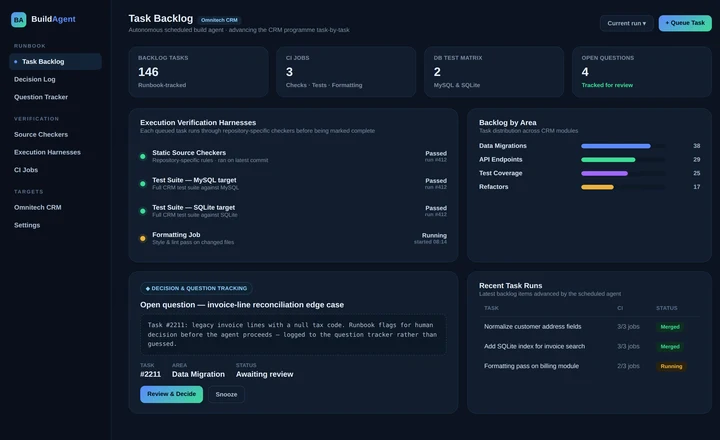
The Autonomous Scheduled Build Agent is a concrete example of an agent doing real, bounded work: on each run it selects one backlog item, follows a repository-specific runbook, records its decisions, and must pass static checkers and execution verification harnesses before the work is marked complete. Human decision points stay explicit in the programme. That is the shape of an agent worth building — narrow scope, verifiable output, and a person accountable for direction — rather than an open-ended assistant asked to do everything and trusted to have done it right.
02بالتفصيل
Tools, boundaries, and verification are the real work
The model is the smallest part of an agent. Most of the engineering is in the surface around it: the tools the agent may call, the boundaries on what it may touch, the checks that decide whether a step succeeded, and the record of what it did and why. On the build agent that took the form of repository-specific checkers and execution harnesses that gate completion, plus explicit decision and question tracking. Any agent engagement here spends its effort in the same places, because that is what makes an agent's output trustworthy instead of merely plausible.
03بالتفصيل
Evaluation: knowing whether the agent is actually good
An agent that cannot be measured cannot be improved or trusted. Before scaling one, you need a way to tell a good run from a bad one — checkable completion criteria, a record of decisions, and repeatable standards a run must meet. That evaluation layer is designed alongside the agent, not bolted on afterwards, so that changes to prompts, tools, or models can be judged against evidence rather than impressions.
04بالتفصيل
Keeping a human accountable
Autonomy is a spectrum, not a switch. The right level depends on the cost of a mistake: low-stakes, easily-reversed work can run with light supervision, while consequential actions keep a human in the loop by design. A responsible agent makes its decision points visible and its actions reversible where possible, so the team keeps control of the outcomes the agent is producing. This is a deliberate design choice, made per task, not an afterthought.