The question is rarely which AI agent framework is best, but whether you need one at all, and what you give up by adopting it. Frameworks can save you boilerplate around tool-calling, memory, and control flow; they can also add abstraction you have to debug through when something goes wrong at 2am. The right way to choose is by the tradeoffs that show up in operation, not by the feature list on the homepage.
01قراءة الأعمال
Start simpler than the framework wants you to
A lot of agent work does not need a framework. Anthropic's guidance is blunt about this: use the simplest thing that works, and add complexity only when it demonstrably improves outcomes (cited below). A direct loop calling a few well-defined tools is often clearer and more debuggable than a heavy framework, and it keeps you close to what the model is actually doing.
02قراءة الأعمال
What frameworks genuinely help with
When complexity is real, frameworks earn their place by standardising the tedious parts: tool schemas, retries, memory, multi-step orchestration, and tracing. The value is consistency and less glue code. The cost is a layer of abstraction between you and the model's behaviour — which is exactly where agent bugs live — so the framework's observability matters as much as its features.
03قراءة الأعمال
The tradeoffs that matter in operation
Judge a framework by how it behaves when things go wrong: can you see every tool call and decision; can you reproduce a bad run; how hard is it to constrain what the agent may do; and how locked-in are you if you need to change models or hosting? These operational properties decide whether an agent is maintainable, and they rarely appear in a feature comparison.
04قراءة الأعمال
Framework or not, the hard parts are yours
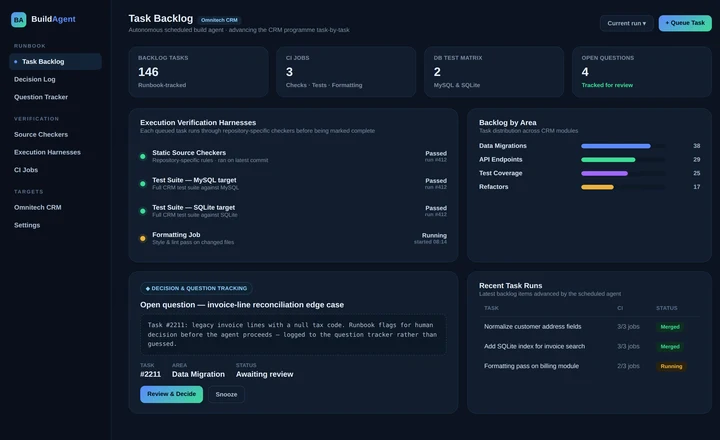
Whatever you choose, the boundaries, verification, and evaluation are still your responsibility — a framework does not decide what the agent is allowed to touch or how you know a run was good. On the Autonomous Scheduled Build Agent, the discipline that made it trustworthy was the checkers, harnesses, and explicit decision points, not any particular library. Pick the tool that keeps those parts visible and under your control.