When generative AI is the right tool, and when it is not
When generative AI is the right tool, and when it is not
Generative AI is worth adopting when a task involves language, unstructured content, or judgement that rules-based software handles badly, and when a wrong answer has a manageable cost or a human stays in the loop. It is the wrong tool when the job needs deterministic, auditable results, when the data to ground it does not exist, or when a smaller, cheaper piece of automation would do the same work more reliably. This service starts from that distinction. Before any build, it establishes which of your problems generative AI genuinely fits, what a responsible version looks like, and what it will take to operate once the launch excitement is over — so the investment goes into systems that keep working, not demos that impress once.
01بالتفصيل
A use-case assessment before a build
Most generative AI disappointment traces back to a use case that was never a good fit, or one that was right but scoped without regard for data, cost, or operations. An assessment looks at the candidate use cases you have in mind, the data available to ground them, the accuracy and latency the task actually requires, and the cost of being wrong. The output is a short, honest ranking: what to do now, what to pilot, and what to leave alone — with the reasoning written down so the decision survives a change of team. This is deliberately separate from implementation, so the recommendation is not shaped by an incentive to sell more build hours.
02بالتفصيل
Systems you can operate, not demos
A demo answers one question in a meeting. A production AI feature has to answer thousands, handle the inputs nobody anticipated, degrade sensibly when a model or provider fails, and stay within a cost envelope. On Pulse / MyOmniHub, AI capabilities were built as part of a modular SaaS platform rather than bolted on, which meant treating retrieval, prompting, and fallback as ordinary system components with the same operational discipline as the rest of the platform. The same standard applies here: an AI system is designed to be run, monitored, and paid for month after month, not just to pass a first look.
03بالتفصيل
Grounding, retrieval, and keeping outputs honest
Generative models are fluent whether or not they are correct, so most of the engineering in a trustworthy AI feature is the work that surrounds the model: grounding answers in your own data, retrieving the right context, constraining what the system is allowed to claim, and giving people a way to see where an answer came from. In data-heavy work such as ProfileDriver's marketing intelligence, the value was never the model alone but the pipeline and validation around it. Expect the same emphasis here — the model is a component, and the reliability comes from the architecture around it.
04بالتفصيل
Agents, where they earn their place
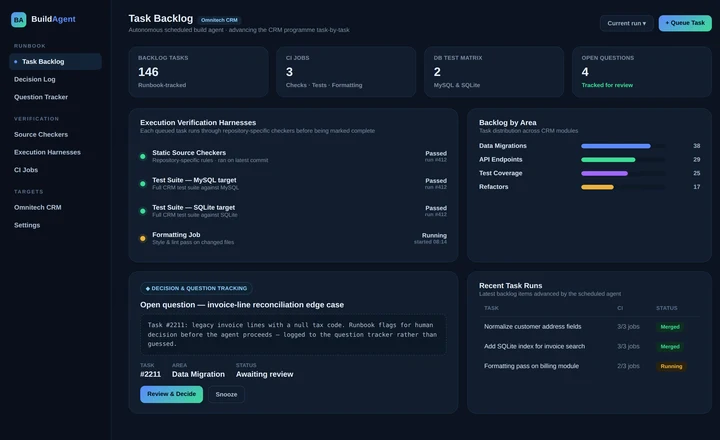
Autonomous and semi-autonomous agents are useful when a task has clear tools, checkable results, and a tolerance for supervision — and a liability everywhere else. The Autonomous Scheduled Build Agent is a concrete example of an agent doing real, bounded work on a schedule rather than a general assistant promised to do everything. When an engagement points toward agents, the same test applies: define the tools, make the results verifiable, set the boundaries, and keep a human accountable. If a simpler generation or retrieval step does the job, that is what gets recommended.